

Resources to Support Your Career Velocity™ Journey
The executive job market has changed—and being “qualified” is no longer enough. In these curated Forbes Coaches Council articles and 50+ podcast guest appearances on my Spotify playlist, I share insider strategies from my experience as an executive recruiter and coach to help you understand how recruiters really work, why executive presence matters as much as skills, and how a proven system like Career Velocity™ can transform your search. Each piece pulls back the curtain on what it really takes to stand out, so you don’t just compete, you compete to win.
PODCAST APPEARANCES
Listen to my Spotify playlist
PUBLICATIONS
These articles align with each phase of the Career Velocity™ framework. Just like in the book,
Qualified Isn’t Enough, start with the foundation—then move step by step through the strategies that set you apart.
Recommended Reading: As You Begin Career Velocity™
It is recommended that you read both the introduction chapter of Qualified Isn’t Enough
and the following foundational support articles to set yourself up for Phase 1.
Executive Search: How To Get On Recruiters’ Radars And Land High-Level Opportunities
If your phone isn’t ringing with recruiter calls, it’s not because you’re not good enough—it’s because you’re invisible. Even the strongest track record won’t matter if decision-makers can’t find you. This article reveals the visibility strategies that put you in a recruiter’s line of sight so you can land interviews.
Will An Executive Recruiter Find A Job For Me? Three Recruitment Models And How To Leverage Relationships With Recruiters
If you’ve ever assumed a recruiter’s job is to find you a role, you’re already at risk of disappointment. Recruiters don’t work for candidates—they work for the companies paying their fees. This article introduces the “talent scout” vs. “talent agent” example, breaks down the three recruitment models, and shows how to build relationships with recruiters the right way, so you stop waiting for a call that may never come.
Navigating The Executive Job Market: Beyond Skills And Experience
At the executive level, your résumé only gets you in the door—after that, everyone has comparable credentials. What separates finalists isn’t another bullet point of experience, but the intangible qualities of executive presence, emotional intelligence, and leadership storytelling. This article reveals how to showcase those differentiators so decision-makers see you as the trusted leader they can bet on.
Career Velocity: The Nine-Step System To Help You Win Leadership Roles
Being qualified won’t carry you to the finish line—at the executive level, you need a system. This article introduces Career Velocity™, a nine-step framework that helps leaders define their story, prepare with precision, and attract opportunities instead of chasing them. If you’re tired of spinning in a reactive job search, here’s how to flip the script and move your career forward with purpose.
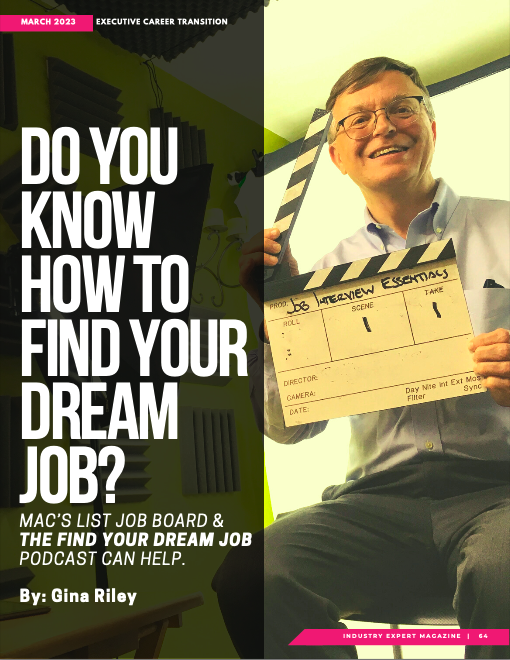
Do You Know How To Find Your Dream Job? Mac Prichard Shares Lessons From Decades In Career Strategy
With over 40 years in communications and two personal bouts of unemployment, Mac Prichard has built one of the most trusted platforms for job seekers. In this interview, he explains why timeless job search principles still matter, how candidates can avoid being the “best-kept secret,” and why his Find Your Dream Job platform has become a gold-standard resource for practical, actionable advice.
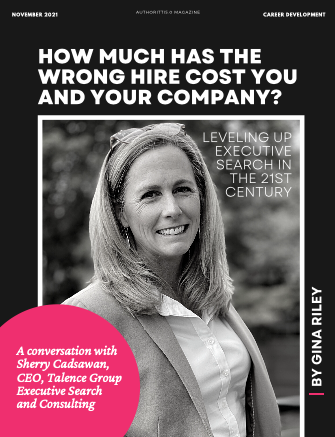
Leveling Up Executive Search in the 21st Century with Sherry Cadsawan
What really drives a successful executive hire—and why do so many companies get it wrong? In this interview, Sherry Cadsawan, CEO of Talence Group, shares how her firm’s SMART model shifts the focus from résumés and pedigree to authentic leadership, values alignment, and long-term impact. Her approach reveals why boards and CEOs can’t afford to rely on gut feel—and how executives who prepare strategically stand out as the obvious choice.
Follow These Five Steps To Earn An Executive-Level Interview
Too many executives launch a job search by dusting off an old résumé or scrolling job boards—only to find themselves stalled. In this piece, I lay out five foundational steps every leader should take first: integrating assessments, clarifying leadership philosophy, mapping career chronology, pulling out measurable results, and preparing a “business solution” that sets you apart in final interviews. If you want to compete at the highest level, these are the strategies that transform your story from forgettable to unforgettable.

Create Your Own Luck: Nine Ways To Increase Your Odds Of Landing A Job Faster
Most executives wait to be “tapped” for their next role, but that passive mindset slows progress. In Create Your Own Luck: Nine Ways To Increase Your Odds Of Landing A Job Faster, Gina Riley shows how leaders can shift from waiting to acting—by clarifying career targets, building a career data vault, leveraging networking and thought leadership, and even preparing finalist presentations. The message is clear: stop hoping to be discovered and start creating momentum through proactive, strategic steps that put you in the line of sight for real opportunities.
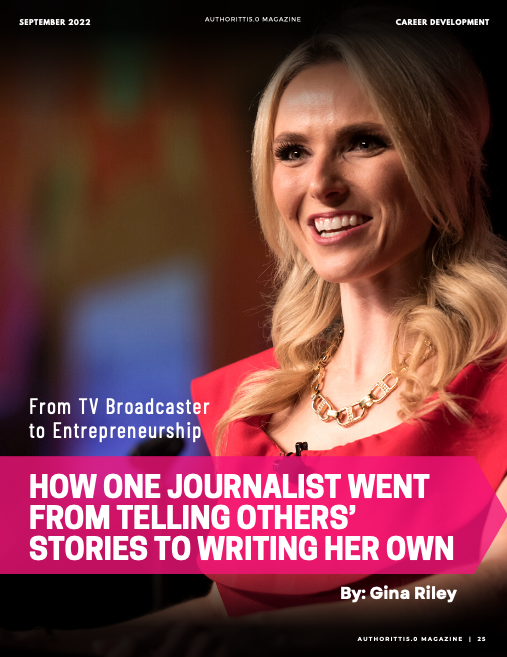
Kristy Siefkin – How One Journalist Went From Telling Others’ Stories To Writing Her Own
After years of telling other people’s stories on television, Kristy Siefkin faced a crossroads: follow the safe corporate path or design a career that truly lit her up. Through deep reflection, 85 informational interviews, and the courage to leave stability behind, she discovered entrepreneurship was her best fit. Her journey to launching Kristy Siefkin Communications is a powerful example of how clarity and courage can transform restlessness into purpose.
Three Year-End Career-Proofing Questions – Assess Your Company’s Prospects, Your Value, And Ways To Start A Career Transition
Uncertain markets put every professional on notice: your role is only as secure as the value you bring and the foresight you apply. This article poses three pivotal questions executives should ask themselves at year’s end—about company health, personal contribution, and future readiness—that can reveal whether it’s time to stay the course or prepare a strategic transition. A must-read for leaders who want to safeguard their careers and stay ahead of disruption.
Phase 1 – Clarify & Craft Your Story
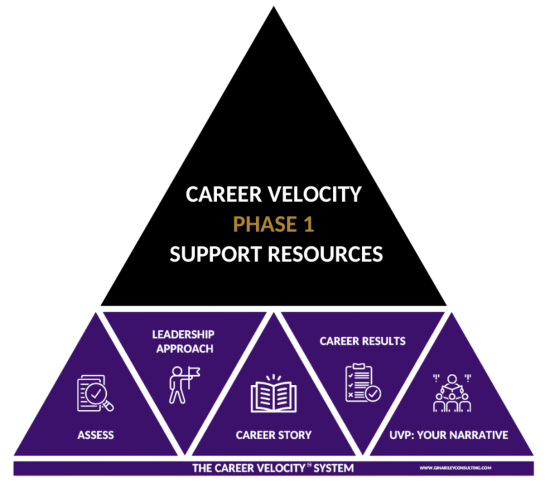
The moments that make or break executive careers often happen before you realize it—when you wing your story, rely on a generic résumé, or recycle an elevator pitch in the wrong setting. These articles spotlight the unseen obstacles that hold leaders back and reveal how to replace them with clarity, strategy, and storytelling that wins.
Stop Winging It: Why Your Executive Career Story Can Make Or Break Your Next Opportunity
Credentials get you in the room—but it’s your story that closes the deal. Too many executives wing their introductions, ramble through résumés, and miss the very moment that could set them apart. This article shows why clarity and storytelling—not just experience—determine whether you land the role or come in second without knowing why.
Your Résumé Isn’t The Starting Point—Your Career Data Vault Is
Most executives assume their résumés tell the whole story—but without proof points, they blend into the crowd. A well-built career data vault becomes your secret weapon: a private repository of results, scope, and strategic impact that powers sharper résumés, stronger LinkedIn profiles, and compelling interview stories. This article shows you what belongs in your vault and why building it now is the move that separates candidates who get overlooked from those who get pulled forward.
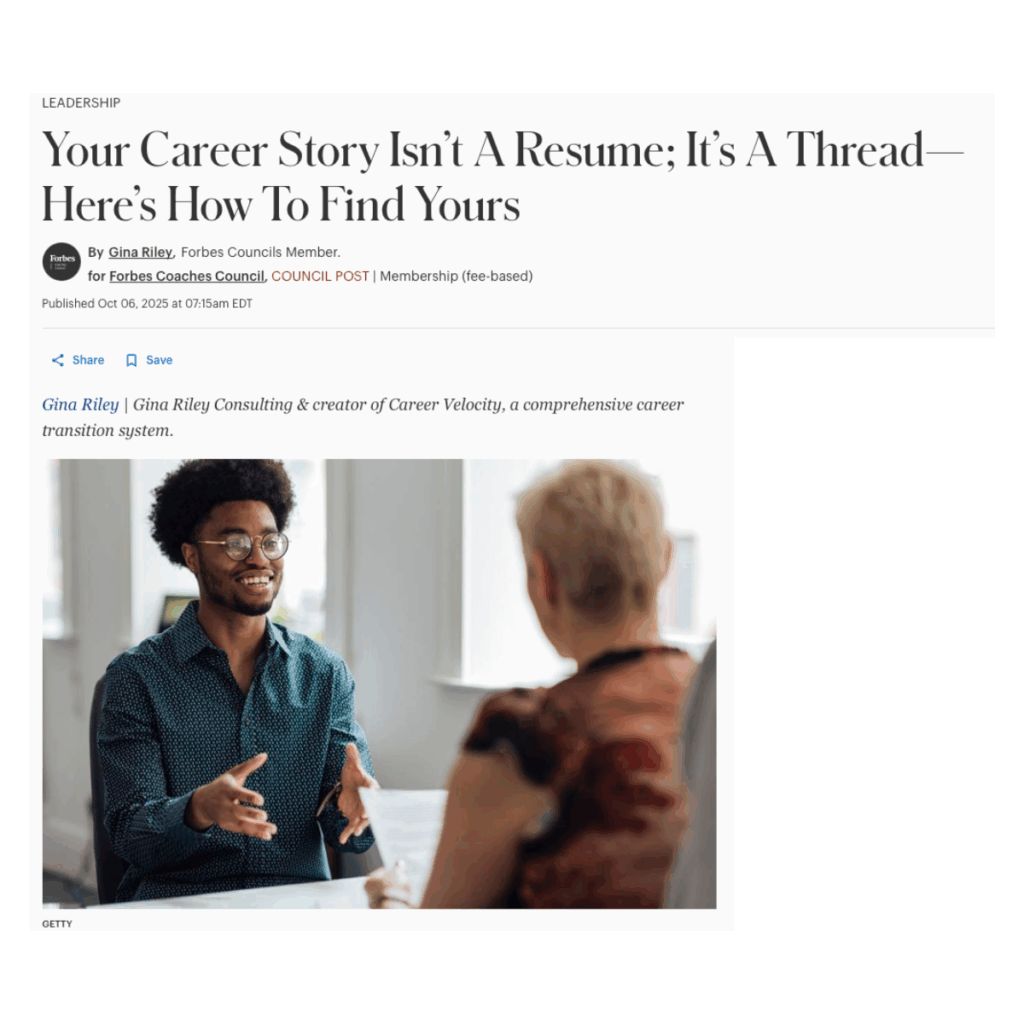
Your Career Story Isn’t a Résumé; It’s a Thread—Here’s How To Find Yours
Every leader has a pattern running through their career—a thread that reveals how they create impact and why their work matters. In this Forbes article, Gina Riley explains how uncovering that thread transforms your résumé from a list of roles into a story of purpose, relevance, and leadership identity. When you can name the theme that connects your decisions, achievements, and values, you stop reciting history—and start communicating the story only you can tell.

Using Your Elevator Pitch Might Be Costing You Opportunities
An elevator pitch can spark curiosity at a networking event—but in a high-stakes interview, it can sink you. “Tell me about yourself” isn’t filler; it’s the moment that frames how every decision-maker sees you. This article shows why you need a strategic TMAY (Tell Me About Yourself) story instead—and how to craft one that makes hiring you the obvious choice.
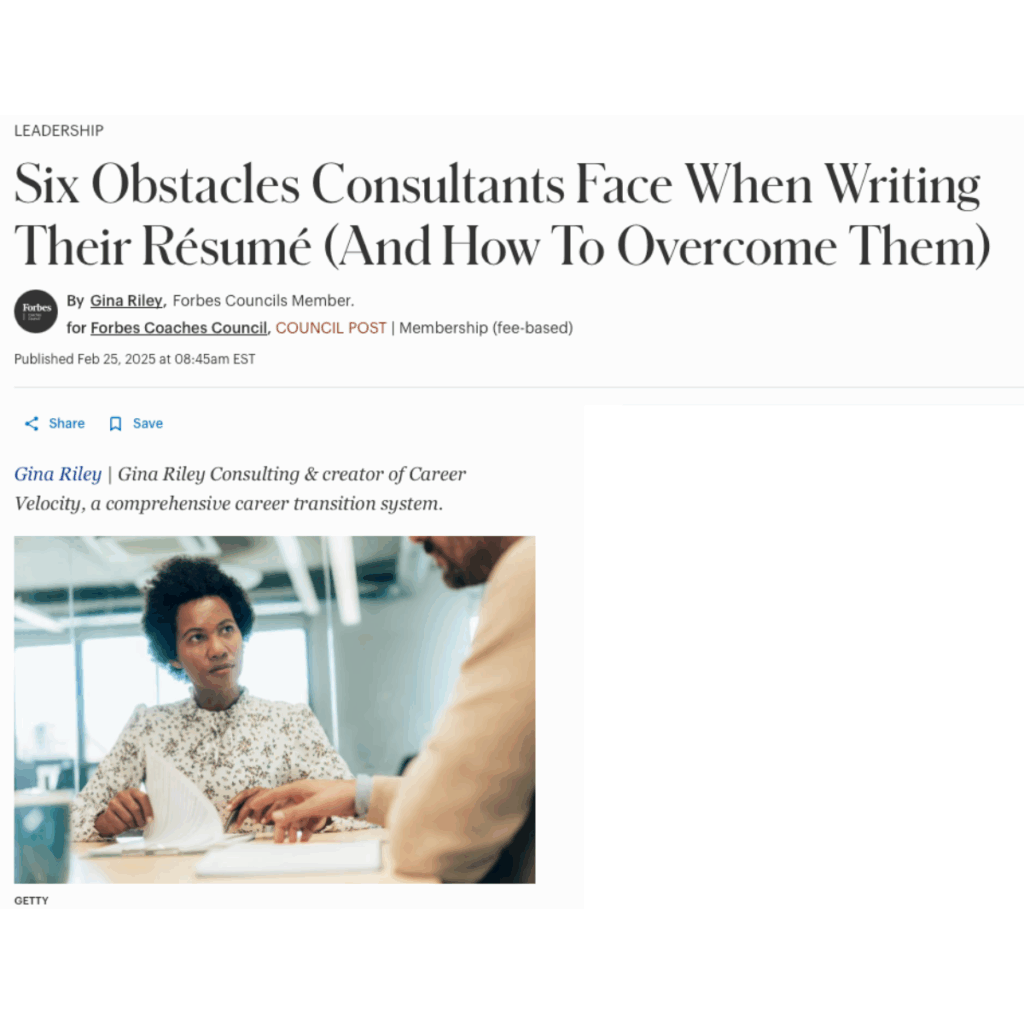
Six Obstacles Consultants Face When Writing Their Résumé (And How To Overcome Them)
Consultants often advise others with confidence yet stumble when asked to package their own careers. From NDAs to fragmented projects, these challenges can make even seasoned professionals sound vague or undervalued. This article unpacks six common résumé pitfalls consultants face—and shows you how to turn them into a compelling story of impact and leadership.

Win the Job by Knowing Your Strengths
Too many executives confuse their skills with their true strengths—and it costs them interviews. This article reveals why uncovering and articulating your innate talents, values, and motivations is the missing piece in building a career story that resonates with decision-makers. If you’ve been relying on your résumé alone, you’ll want to see why self-awareness is the real key to landing the job.

Are You an Adaptive Leader?
Today’s toughest business challenges can’t be solved with technical expertise alone—they demand adaptive leadership. This piece breaks down six principles every executive must master to guide teams through uncertainty, conflict, and change. If you can’t clearly show how you help people adapt, you may be missing the most critical proof of leadership in your interviews.
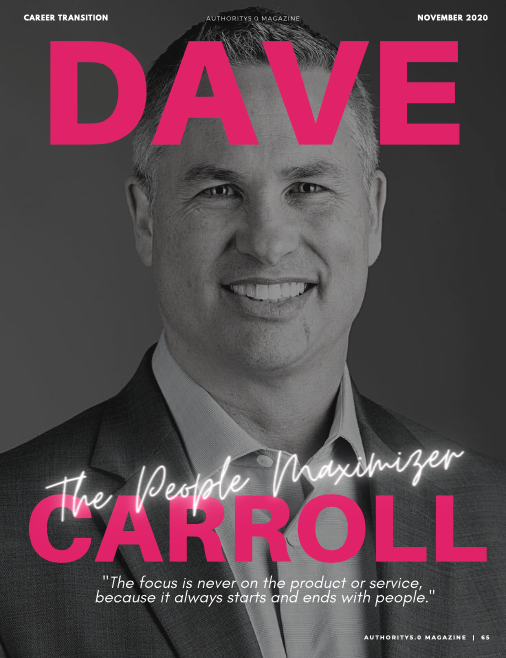
Dave Carroll: The People Maximizer
True leadership isn’t about products, quotas, or transactions—it’s about people. In this feature, Dave Carroll shows how leading with heart, compassion, and a “people first” mindset transformed teams, customers, and entire communities. His story is a living example of how your leadership approach can define culture, create trust, and deliver extraordinary results.
Phase 2– Marketing Yourself Strategically
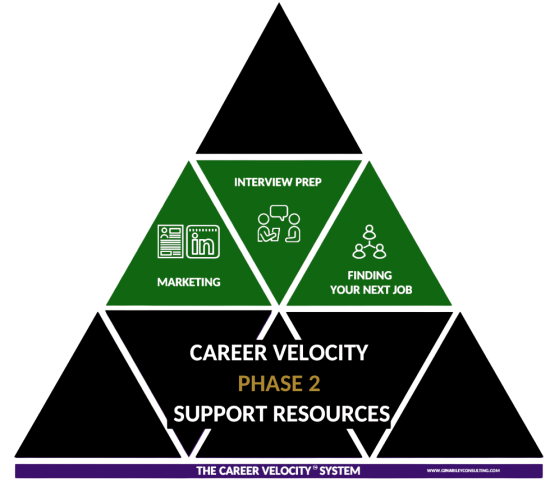
Landing an executive role isn’t about being the most qualified on paper—it’s about showing up in interviews as the leader people want to follow. Too many executives stall out in finalist rounds because they underestimate the prep required, mismanage their story, or get outpaced by insiders who seem like the safer bet. These articles reveal the hidden pitfalls of executive interviews and the strategies that transform you from “qualified” to the candidate of choice.
INTERVIEW PREP: BE THE MOST PREPARED PERSON IN EVERY ROOM
8 Reasons Why You Did Not Land The Interview
If you’ve been applying for roles and hearing nothing back, the problem isn’t always your qualifications—it’s the blind spots in how you present them. From keyword missteps to incomplete LinkedIn profiles and missed timing, small errors can quietly derail your chances before you ever get a call. This article breaks down the eight hidden interview blockers and how to fix them so you can finally make the short list.
The Executive Interview Danger Zone: Navigating Unprepared Interviewers
Even the sharpest executives can be thrown off by an unprepared interviewer—one who relies on gut instinct instead of structured evaluation. Left unchecked, these situations can derail your candidacy and reinforce bias. This article shows how to recognize the “danger zone” and turn it into an opportunity to demonstrate leadership, composure, and strategic insight.
Executive Hiring: What You Need To Know To Edge Out The Internal Candidate
Going head-to-head with an internal candidate can feel like a losing battle—they already know the culture, the people, and the playbook. But external executives win these roles all the time by showing up with a unique value proposition that goes beyond “fit.” This article reveals how to position yourself as low-risk, high-reward, and the clear choice even against the insider favorite.
Executive Interviews: Communicating Your Value Without Losing Your Humility
Many leaders downplay their impact in interviews, worried about sounding boastful—yet underselling yourself can cost you the role. The key is to balance authenticity with authority: showing measurable results while staying true to your collaborative values. This article outlines six strategies to help you articulate your achievements with confidence, clarity, and humility.
Becoming The RARE Executive Candidate: Why Good Isn’t Good Enough In Final Interviews
Plenty of executives make it to the final round—only to fall short because they treat it like another conversation instead of a high-stakes audition. Degrees and titles are table stakes; what separates offer-winners is preparation, presence, and the ability to connect their story to the organization’s future. This article introduces the RARE Candidate framework and shows how to transform pressure moments into career-defining wins.
Apply New Rules Of Executive Presence To Your Next Executive Interview
Technical expertise gets you in the door—but it’s your executive presence that wins the role. This article introduces the “new rules” of appearance, communication, and gravitas—anchored in authenticity, inclusiveness, and the ability to connect across diverse perspectives. With examples and interview prep strategies, it shows how to translate research on modern executive presence into stories that inspire trust and set you apart in finalist rounds.

Executive Presence: The Missing Factor in Interview Success
You can walk into a finalist interview with the right résumé, experience, and credentials—and still lose the offer if you don’t project executive presence. Across three articles, Gina Riley breaks down the three pillars of executive presence—appearance, communication, and gravitas—and shows how they directly shape how decision-makers perceive your leadership. Backed by research and search experience, these insights reveal why subtle missteps (like voice pitch, posture, or lack of decisiveness) can derail even the strongest candidates. For executives preparing for high-stakes interviews, this series is a practical playbook for demonstrating composure, credibility, and confidence under pressure—the very qualities Qualified Isn’t Enough identifies as the difference between being a finalist and being the chosen leader.
NOT GETTING PROMOTED? – Part 2 : Communication
In 1991, I forever changed the way I spoke. I was in college, interning for a top communication trainer who brought me on assignment for a day-long team leadership development consultation at Motorola. “I don’t understand why I can’t get the men on my team to listen to me or give me respect when I speak,” a young female engineer painfully conveyed during the training.
NOT GETTING PROMOTED? Part 3 : Gravitas
In 1991, I forever changed the way I spoke. I was in college, interning for a top communication trainer who brought me on assignment for a day-long team leadership development consultation at Motorola. “I don’t understand why I can’t get the men on my team to listen to me or give me respect when I speak,” a young female engineer painfully conveyed during the training.
NETWORKING, JOB SEARCH STRATEGY & HIDDEN OPPORTUNITIES: BUILDING VISIBILITY BEYOND JOB BOARDS
Executives often underestimate the power of relationships, visibility, and intentional positioning in securing their next role. At this level, some opportunities don’t appear on job boards; instead, they emerge through strategic conversations, establishing credibility in the right circles, and being top of mind when leadership positions become available.
These articles highlight how executives can shift from reactive searching to proactive visibility—leveraging informational interviews, recommendations, thought leadership, and even volunteer service to uncover the “invisible” job market. Together, they form a playbook for cultivating influence and building momentum long before an official posting ever goes live.
6 Reasons Job Boards Are Slowing Your Executive Job Search (And What You Should Do Instead)
Job boards feel productive, but for executives, they’re often a trap—stacking you against hundreds of applicants while overlooking the hidden, referral-driven market where most leadership roles are filled. This article breaks down six reasons job boards fail senior leaders, from ATS keyword scoring to “pre-filled” roles and shows why relying on them creates a false sense of progress. Instead, it offers higher-ROI strategies—such as consulting as a bridge, thought leadership, and volunteer leadership—that put you in the right conversations before roles even become public.
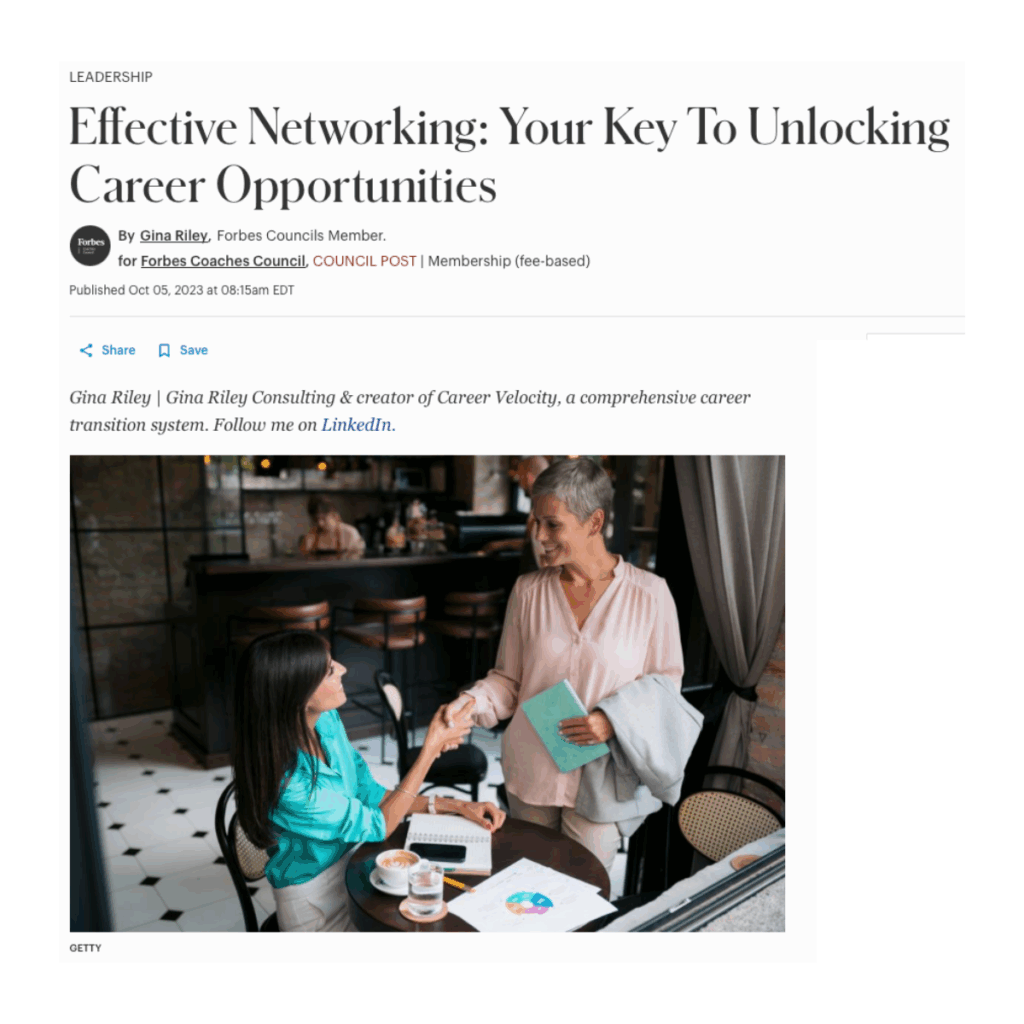
Effective Networking: Your Key To Unlocking Career Opportunities
Most executives miss opportunities not because of lack of connections, but because they walk into networking conversations unprepared. This article outlines how to avoid vague storytelling, come with clarity, and make specific asks—so that contacts can truly help. With research, preparation, and consistent follow-up, networking becomes less transactional and more transformational.
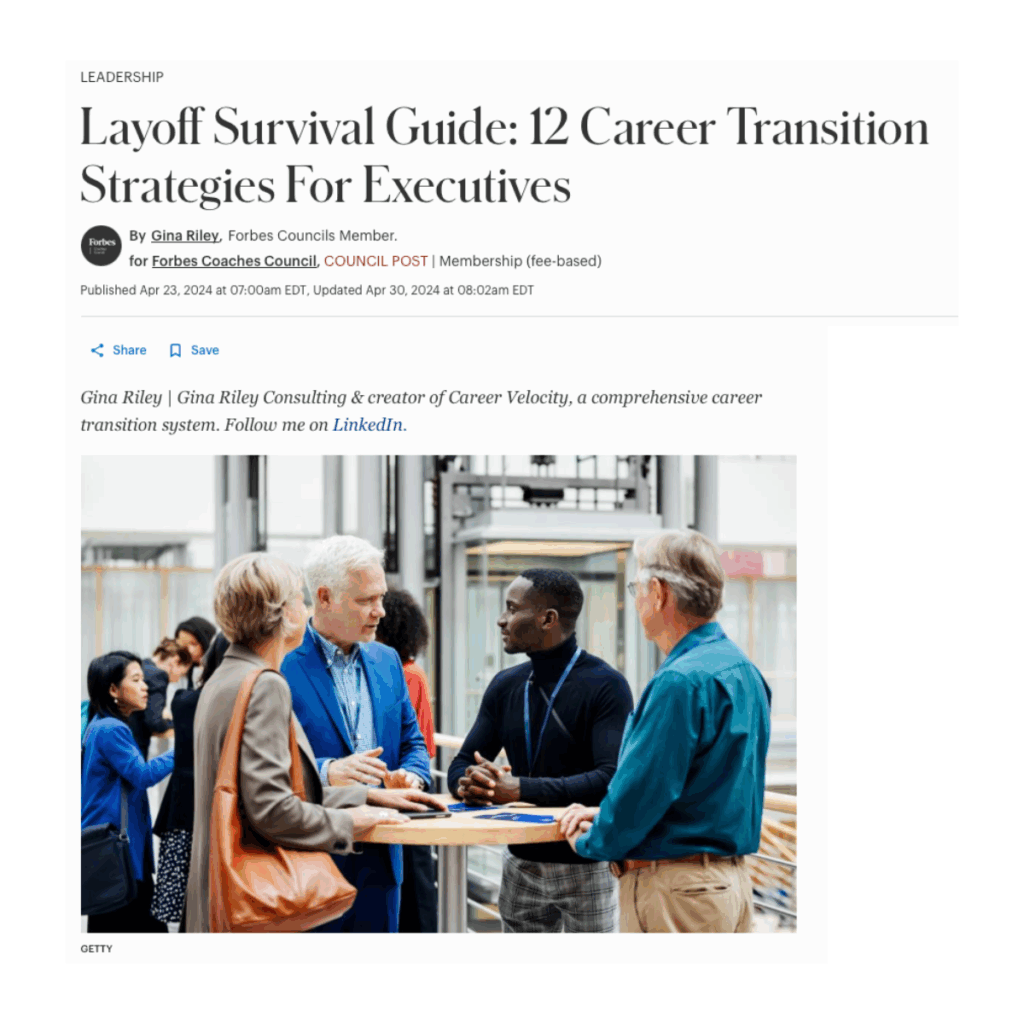
Layoff Survival Guide: 12 Career Transition Strategies For Executives
A layoff doesn’t have to derail your career—it can become a launchpad. This guide offers 12 strategies for executives, including documenting achievements before systems are shut off, strengthening your UVP, consulting as a bridge, negotiating severance wisely, and embracing thought leadership. It reframes career disruption as a chance to reposition and accelerate growth.
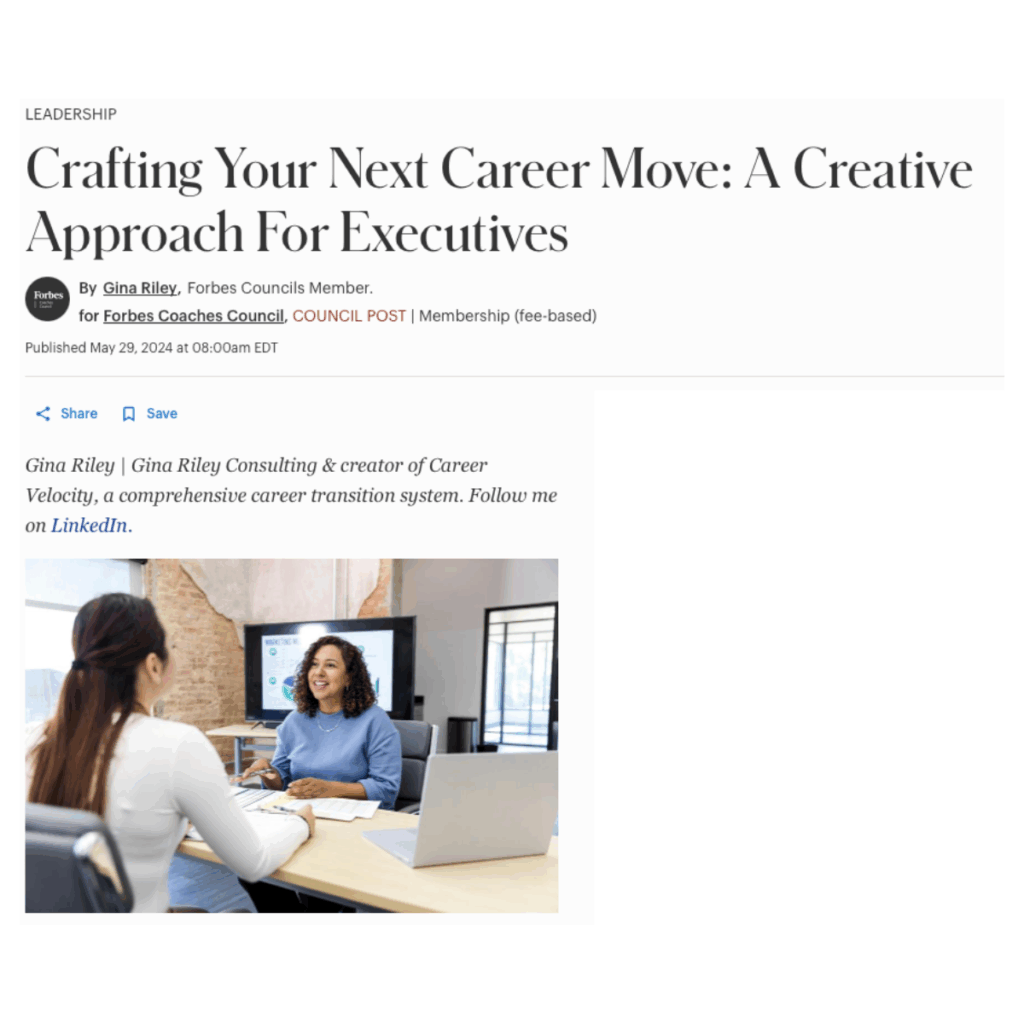
Crafting Your Next Career Move: A Creative Approach For Executives
Sometimes the best opportunities come from flipping traditional job search strategies. Here, executives learn how to reverse-engineer recruiter tactics to connect with decision-makers—through niche boards, targeted networking, creative proposals, and even hosting events. The message is clear: creative positioning sets leaders apart in a crowded market.
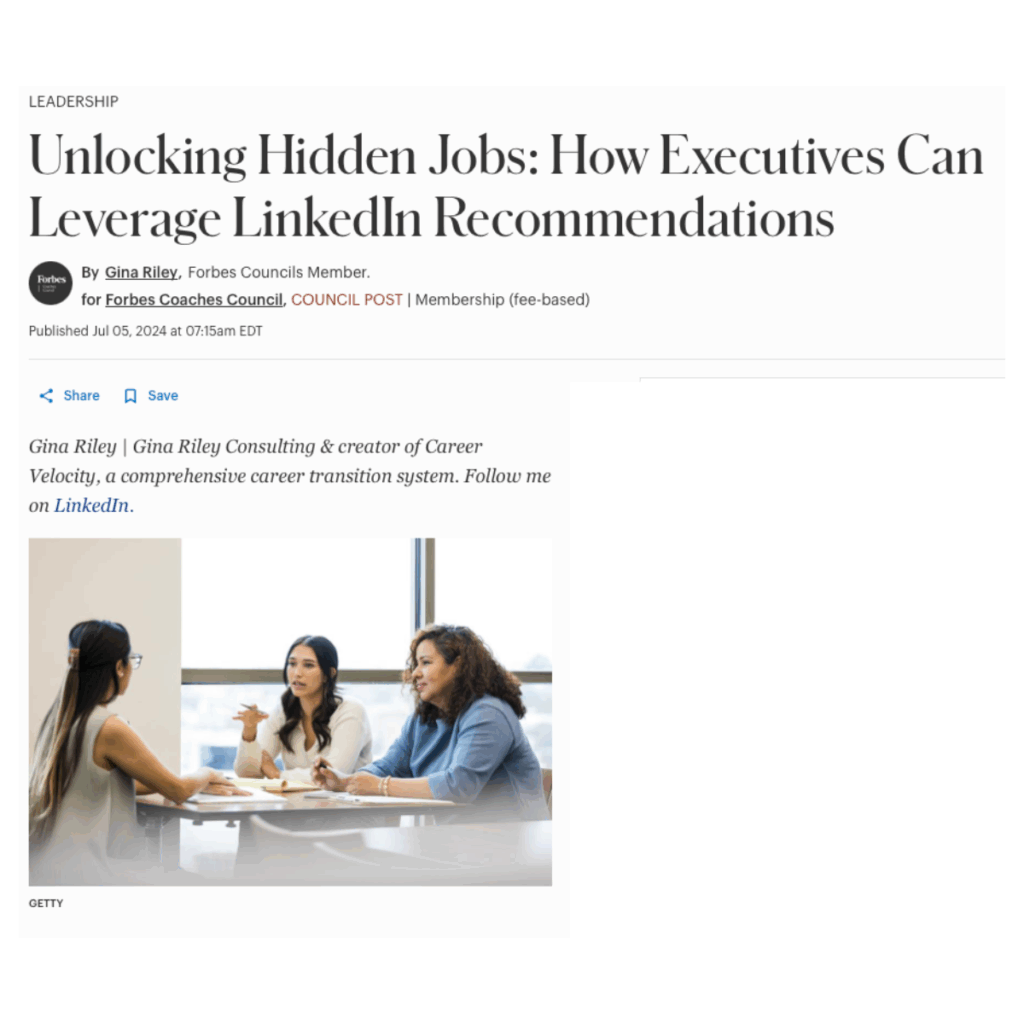
Unlocking Hidden Jobs: How Executives Can Leverage LinkedIn Recommendations
LinkedIn recommendations are more than digital endorsements—they can open doors to hidden roles. This article shows how executives can re-engage dormant ties, raise visibility, and turn recommendation requests into career-defining conversations. Tammy’s story illustrates how credibility plus storytelling can uncover unposted opportunities and accelerate advancement.
Leverage Informational Conversations To Unlock Invisible Executive Jobs
Informational conversations are the gateway to opportunities that never hit job boards. Gina outlines five strategies—from alumni networks to conferences to mentorship—to turn these conversations into authentic, high-value connections. The secret is consistency and genuine curiosity, which build trust long before an opportunity becomes public.
How To Land Your Next Leadership Role Without A Job Board
At the executive level, the best roles are rarely posted. This article lays out five strategies for moving beyond job boards: clarifying your UVP, leading with soft skills, consulting as a bridge, investing in thought leadership, and demonstrating leadership through service. The takeaway: visibility—not postings—drives access to senior roles.
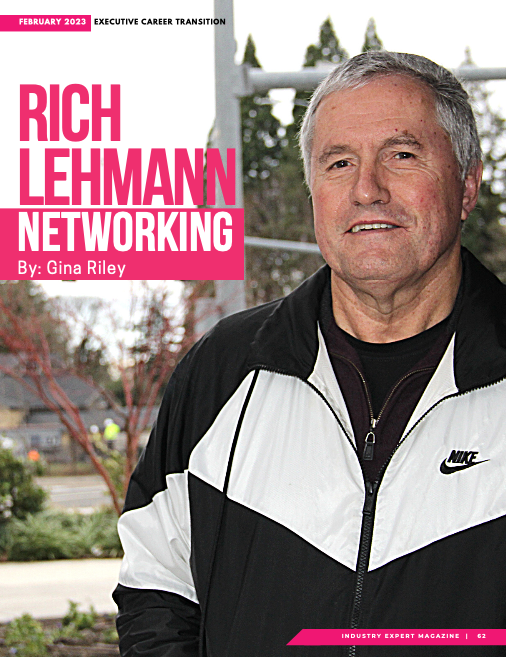
Rich Lehmann — 99 Conversations to Nike: A Masterclass in Strategic Networking
Laid off in a down market and facing age and industry barriers, Rich Lehmann didn’t “spray and pray”—he ran a disciplined campaign: 99 targeted conversations at Nike, a clear value proposition tied to LEAN, 20-minute asks, meticulous prep, and handwritten follow-ups. His story shows how humility, curiosity, and consistent relationship-building can beat job boards and gatekeepers—especially when you tailor your message to a company’s real needs. If you want a playbook for turning loose ties into warm introductions (and mentors) that open doors, this is it.
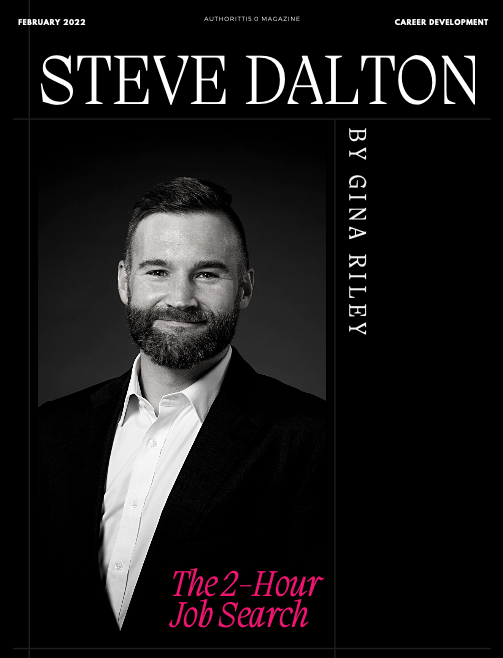
Steve Dalton — The 2-Hour Job Search: A Recipe for Turning Strangers into Advocates
Most executives waste energy perfecting résumés or chasing job boards when the real key to landing leadership roles is building advocacy through networking. In this interview, Steve Dalton—author of The 2-Hour Job Search—shares his “recipe” approach: using data, structured outreach, and the TIARA framework to turn strangers into advocates who open hidden doors. His message is clear: at senior levels, success doesn’t come from being the loudest—it comes from following a system that maximizes every minute and positions you as the candidate others champion. Find more about how Dalton’s approach ties to Step 8 of Career Velocity in Qualified Isn’t Enough.
Make Networking Your Professional Boomerang
Networking isn’t about asking for a job—it’s about building intentional, mutually beneficial relationships that will boomerang back opportunities when you need them most. In this article, Gina Riley shares three powerful strategies: building a personal “Board of Directors,” cultivating networks outside your company walls, and embracing unexpected connections that can evolve into transformative partnerships. Through real stories of women leaders, it illustrates how generosity, truth-telling, and collaboration create a career support system that accelerates growth and opens doors you never knew existed
Lisa Fain — The Unseen Benefits of Mentoring Relationships
What if mentorship wasn’t just for early-career professionals but one of the most powerful tools for leaders at every stage? In this interview, Lisa Fain, CEO of the Center for Mentoring Excellence, explains why great mentoring is reciprocal, rooted in learning, and essential for building inclusive leadership cultures. She draws clear lines between mentors, sponsors, and coaches, and offers practical guidance for finding the right mentor, setting clear expectations, and creating lasting growth. Her insight is a wake-up call: leaders who embrace mentoring don’t just elevate others—they expand their own perspective, resilience, and career satisfaction
Open Job Opportunities With Online Meeting Platforms: How Meetup Builds Community, Connection, And Is A Conduit To Career Growth
Networking can feel intimidating, especially for executives who aren’t sure how to “get out there.” In this interview with David Siegel, CEO of Meetup, we explore how authentic connection—not transactional networking—creates unexpected opportunities. From hidden jobs to lasting friendships, Siegel shows how putting yourself “in the line of fire of opportunities” through communities of shared interest can open doors you never imagined.
Phase 3– Thought Leadership
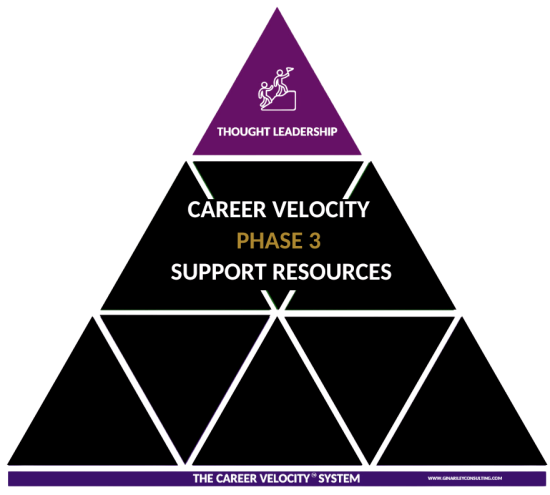
At the executive level, opportunities don’t just appear—you attract them. Thought leadership is how you move from being qualified to being sought after. By consistently sharing ideas, models, and insights, you build credibility that pulls the right opportunities toward you.
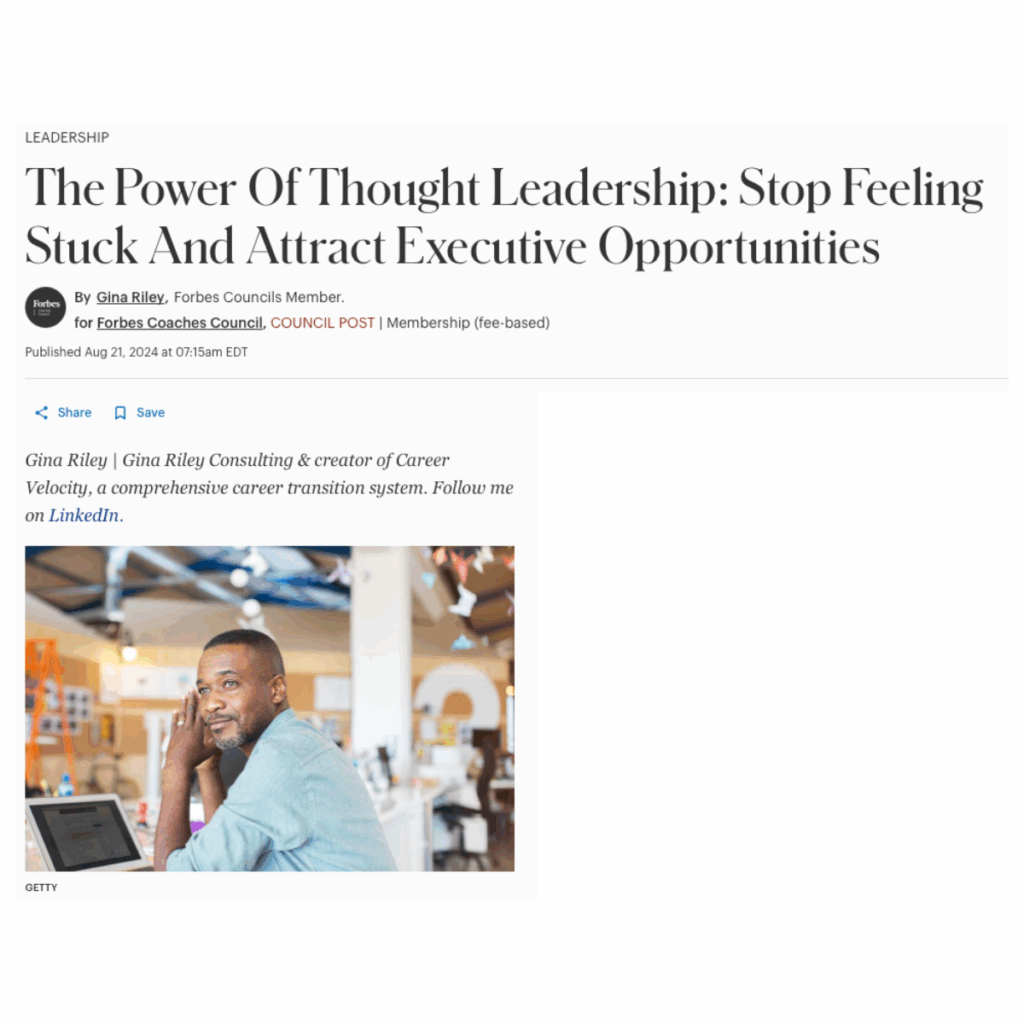
The Power Of Thought Leadership: Stop Feeling Stuck And Attract Executive Opportunities
If recruiter calls have slowed, thought leadership may be your missing strategy. This article shows how executives can create a “pull strategy” by consistently sharing insights, frameworks, and experiences that position them as trusted authorities in their fields. With examples from clients who turned visibility into promotions and opportunities, it proves that thought leadership isn’t about self-promotion—it’s about service, credibility, and attracting roles that align with your expertise.
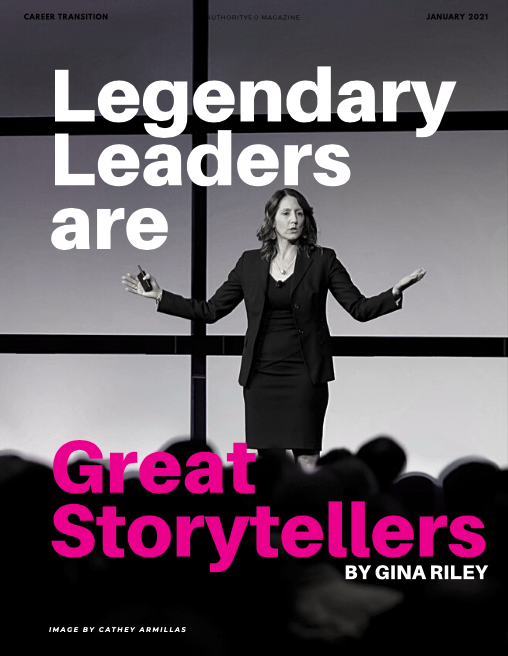
Legendary Leaders Are Great Storytellers
Thought leadership isn’t about titles; it’s about ideas that inspire action. In this interview, Cathey Armillas underscores the power of storytelling and “memorable models” to establish credibility and differentiate your voice. Leaders who lean into authentic stories, frameworks, and bold statements become recognized as trusted authorities who move people to think and act differently.

If You Call Yourself a Thought Leader, You Probably Aren’t One
True thought leaders don’t declare themselves—they earn the title by consistently offering insights, context, and solutions that help others succeed. Lee McEnany Caraher emphasizes servant leadership, credibility through consistent communication, and the long-term effort required to become known for expertise. Her message is clear: stop chasing influence, focus on being genuinely helpful, and thought leadership will follow.